Bat Houses - Half a Million Neighbors
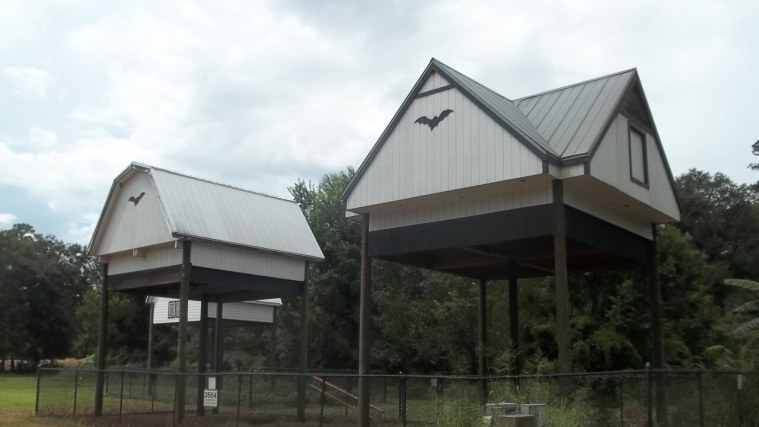
Photo: Ebyabe, CC BY-SA 4.0 (cropped)
A stop on University of Florida Campus Walk, a free self-guided tour.
Those tall wooden structures on stilts are home to what UF calls possibly the largest bat colony east of the Mississippi. The story starts with a fire. In 1987 a blaze destroyed historic Johnson Hall, whose attic sheltered a colony of bats. The displaced bats moved into the athletic stadiums, where their droppings rained on fans and athletes. In 1991, with $25,000 from an athletics booster, UF built a bat house here and moved the bats in.
At first most of them flew away within days. Within a few years, though, the colony settled in and grew into a maternity colony of mostly females. A bigger bat barn followed in 2010 and another in 2017, and the worn-out original house has since come down. UF estimates about 500,000 bats roost here, mostly Brazilian free-tailed bats.
Come back around sunset. About 15 minutes after the sun goes down, the bats pour out in a long, swirling stream to hunt. Watch from the viewing area, and never touch a bat.
Getting here: Walk a few minutes north to Museum Road. The bat houses stand beside the Field and Fork gardens, across the road from Lake Alice.
Did you know?: Scientists estimate the colony eats about 2.5 billion insects a night, roughly 2,500 pounds of moths, mosquitoes, flies and beetles.
Photo op: At dusk, stand back and aim toward the brighter western sky so the stream of bats shows up as dark specks. Turn off your flash.
More on Wikipedia: Mexican free-tailed bat · Lake Alice
Stops on this tour
- Century Tower - The Campus Clock with 61 Bells
- University Auditorium - Gothic Hall, Giant Organ
- Plaza of the Americas - Campus Living Room
- Library West and Smathers Library - Two Eras of Study
- Ben Hill Griffin Stadium - Welcome to the Swamp
- 34th Street Wall - Gainesville's Public Notebook
- Florida Museum of Natural History - The State's Collection
- Baughman Center - A Quiet Pavilion on the Lake
- Bat Houses - Half a Million Neighbors
- Lake Alice - Alligators at a Safe Distance
- Reitz Union - The Heart of Student Life