Japanese Tea Garden
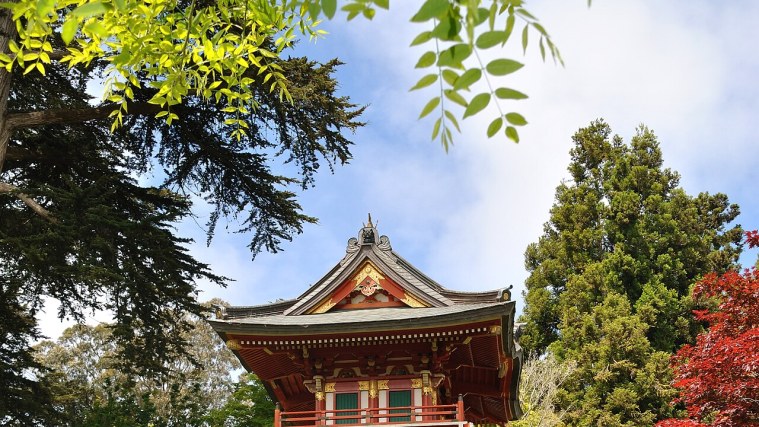
Photo: Asamudra (talk), CC BY 3.0 (cropped)
A stop on Golden Gate Park, San Francisco, a free self-guided tour.
The Japanese Tea Garden began as a Japanese village exhibit for the 1894 Midwinter Exposition. After the fair, Makoto Hagiwara, a Japanese immigrant gardener, took charge and greatly expanded it, and his family lived in the garden and cared for it for decades. It is the oldest public Japanese garden in the United States.
In 1942 the Hagiwaras, like other Japanese Americans on the West Coast, were forced into internment camps, and the city removed them from the garden. They never returned. During the war the garden was renamed the Oriental Tea Garden, and the Hagiwaras' house was torn down. Today a plaque honors the family.
The garden covers about five acres, with a steep arched drum bridge, a pagoda, stone lanterns, a Zen garden of raked gravel, koi ponds and a large bronze Buddha cast in Japan in 1790. The pagoda came from the 1915 Panama-Pacific International Exposition, held in what is now the city's Marina District.
The paths are designed to slow you down. They curve, step up and down, and open onto new views at each turn, a principle of Japanese garden design. The drum bridge is steep enough that its reflection in the water below forms a full circle.
Hagiwara is often credited with introducing the fortune cookie to the United States, served at the teahouse, though others also claim the invention. The teahouse still serves green tea and snacks.
The cherry trees bloom in early spring, and the maples turn red in fall. Admission is charged; arrive early to avoid crowds.
More on Wikipedia: Japanese Tea Garden · Makoto Hagiwara
Stops on this tour
- McLaren Lodge and Sharon Meadow
- Conservatory of Flowers
- Rhododendron Dell
- Music Concourse and Spreckels Temple of Music
- de Young Museum
- California Academy of Sciences
- Japanese Tea Garden
- San Francisco Botanical Garden
- Stow Lake and Strawberry Hill
- Spreckels Lake and Model Yacht Club
- Polo Fields and Speedway Meadow
- Buffalo Paddock - American Bison Herd
- Rainbow Falls and Chain of Lakes
- Dutch Windmill and Queen Wilhelmina Tulip Garden
- Ocean Beach - Western Gateway