Royal Street - Galleries, Ironwork and Street Music
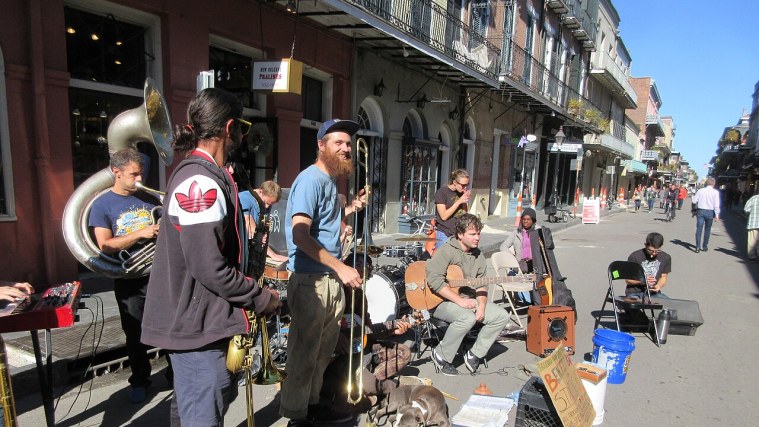
Photo: Infrogmation of New Orleans, CC BY-SA 4.0 (cropped)
A stop on New Orleans French Quarter Walk, a free self-guided tour.
Welcome to Royal Street, laid out as Rue Royale by the French, called Calle Real by the Spanish, and Royal Street by the Americans. Look up at the street-corner signs: blue-and-white Spanish tiles still show the old Spanish names.
The buildings around you tell the city's story. After the fires of 1788 and 1794, owners rebuilt in brick and stucco with courtyards and arched carriageways, in a style shaped by Spain and the Caribbean. Later owners added lacy cast-iron galleries in the 1800s. Walk one block toward St. Peter Street and look at the corner building on your right, known as the LaBranche House, whose iron railings are patterned with oak leaves and acorns.
In 1809 thousands of refugees from the revolution in Saint-Domingue, now Haiti, arrived here, roughly doubling the city's population and adding Caribbean cooking, building and music. In the afternoons a few blocks of Royal close to cars, and musicians, painters and performers take over. Today the street is known for antique shops and art galleries, and window shopping is free.
Getting here: From the Pharmacy Museum, walk up St. Louis Street one block away from the river and turn right onto Royal Street. Stop at the Toulouse Street corner.
Did you know?: The tile street signs were a gift from the government of Spain and were put up around 1960 to mark the Spanish names the streets carried from 1762 to 1803.
Photo op: At the corner of Royal and St. Peter streets, look up at the LaBranche House to frame its oak-leaf ironwork wrapping around the corner.
More on Wikipedia: Royal Street, New Orleans · French Quarter · Haitian Revolution
Stops on this tour
- Jackson Square - The Old Parade Ground
- St. Louis Cathedral - Three Spires on the Square
- The Cabildo - Where Louisiana Changed Hands
- Pharmacy Museum - America's First Licensed Pharmacist
- Royal Street - Galleries, Ironwork and Street Music
- Preservation Hall - Jazz in a Plain Room
- Congo Square - Where the Drums Kept Sunday
- Lafitte's Blacksmith Shop - A Legend in Brick and Timber
- Old Ursuline Convent - The Quarter's Oldest Survivor
- Old U.S. Mint - Coins, Then Jazz
- French Market - Two Centuries of Trading
- Cafe du Monde - Beignets by the Square