Castle Geyser - A Cone Built Over Centuries
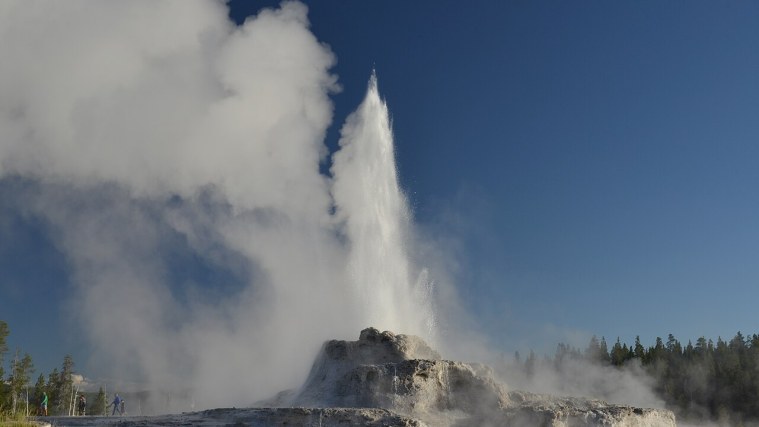
Photo: G. Edward Johnson, CC BY 3.0 (cropped)
A stop on Yellowstone Geyser Country, a free self-guided tour.
That rough, turreted mound beside the path is the cone of Castle Geyser, and it's easy to see how it got its name. Lieutenant Gustavus Doane of the 1870 expedition thought it looked like a ruined castle.
Every bit of that cone is sinter, silica that settles out as hot water spills over and cools. It grows painfully slowly. Scientists once guessed the cone was 5,000 to 15,000 years old, but radiocarbon dating now points to about a thousand years, so it was already growing around the time Norse sailors reached Newfoundland.
Castle erupts roughly every 15 to 17 hours, putting up a column around 90 feet tall for about 20 minutes. Then the water runs out and a roaring steam phase takes over for another half hour or more. If the posted prediction is close, wait for it; the sound alone is worth the time. Stay on the boardwalk: the crust around the cone is thin, and the water beneath it is scalding.
Getting here: From the Inn, follow the paved trail and boardwalks northwest along the Firehole River for about half a mile; Castle's big cone stands right beside the path.
Did you know?: The 2002 Denali earthquake, nearly 2,000 miles away in Alaska, temporarily changed how often Castle erupted.
Photo op: Frame the cone with the Firehole River beside it; during the steam phase, keep the sun behind you so the white plume stands out against the sky.
Nearby: No facilities on the trail; the nearest restrooms and water are back at the Visitor Education Center and the Inn.
More on Wikipedia: Castle Geyser · Gustavus Cheyney Doane
Stops on this tour
- Old Faithful - Nature's Most Famous Clock
- Old Faithful Inn - A Log Lodge Built in One Winter
- Castle Geyser - A Cone Built Over Centuries
- Grand Geyser - The Tallest You Can Plan For
- Morning Glory Pool - A Lesson in Leaving No Trace
- Black Sand Basin - Obsidian Sand and Emerald Water
- Biscuit Basin - Where the Ground Exploded
- Grand Prismatic Overlook - The Rainbow From Above
- Midway Geyser Basin - Up Close With Grand Prismatic
- Firehole Lake Drive - Great Fountain's Back Road
- Fountain Paint Pot - All Four Kinds in One Walk
- Firehole Canyon Drive - Lava Walls and a Waterfall