Brimstone Hill Fortress National Park
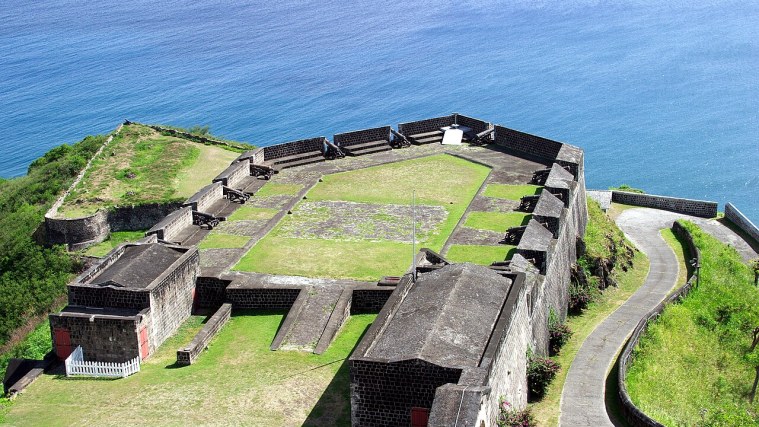
Photo: Ukexpat, CC BY-SA 3.0 (cropped)
A stop on Discover St Kitts Island, a free self-guided tour.
Brimstone Hill Fortress sits on a steep volcanic hill about 800 feet above the west coast. Its name comes from the smell of sulfur, or brimstone, from volcanic vents nearby. The British began fortifying it in 1690 and kept building for about a century. The walls and buildings were constructed by enslaved Africans, who cut and hauled the volcanic stone up the hill. It was so strong that it was called the Gibraltar of the West Indies.
In 1782 a French army besieged the fort for a month. The small British garrison, outnumbered and short of supplies, surrendered, but the island was returned to Britain the following year under the Treaty of Paris. After that, the British strengthened the fort further. It was abandoned by the military in the 1850s and later restored. In 1999 it became a UNESCO World Heritage Site, recognized as an outstanding example of 17th- and 18th-century British military architecture in the Caribbean.
The fortress is a complex of bastions, barracks, cisterns, a hospital and other buildings spread over the hill, linked by steep roads. The walls of the bastions are built of dark volcanic stone and pale limestone, mortared together and several feet thick.
The Fort George Citadel, at the top, has a museum on the fort's history, including the lives of the soldiers and the enslaved builders. From the walls you can see Sint Eustatius and Saba, and on clear days St. Barts, Nevis and Montserrat. The view shows how the fort controlled the sea lanes along the coast.
Admission is charged. Allow at least an hour. The road up is narrow and steep, with sharp turns.
More on Wikipedia: Brimstone Hill Fortress National Park
Stops on this tour
- Port Zante - Basseterre
- Independence Square
- Brimstone Hill Fortress National Park
- Romney Manor and Caribelle Batik
- St. Kitts Scenic Railway
- Fairview Great House and Botanical Gardens
- Timothy Hill Overlook
- Frigate Bay - North and South
- Cockleshell Beach
- Mount Liamuiga Rainforest Trail
- Dieppe Bay Town and Beach
- Wingfield Estate and Old Road Rum Distillery
- South Friars Bay
- The Circus and Downtown Basseterre
- National Museum of St. Kitts