The Cabildo - Where Louisiana Changed Hands
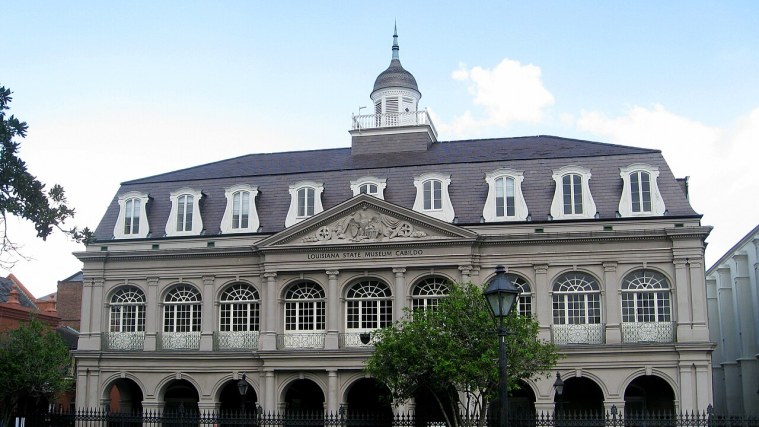
Photo: Jared422, CC BY-SA 3.0 (cropped)
A stop on New Orleans French Quarter Walk, a free self-guided tour.
The handsome building to the left of the cathedral, with arched openings on the ground floor, is the Cabildo. It was built in the 1790s as the seat of the Spanish city council, called the Illustrious Cabildo, after the 1788 fire destroyed the earlier government house. The arches and thick walls are a reminder that much of the Quarter you see today was rebuilt under Spain, not France.
In late 1803 this was where the transfer ceremonies for the Louisiana Purchase took place, turning a huge stretch of the continent into United States territory. The steep mansard roof on top came later, in 1847, a French touch added under American rule.
From 1868 to 1910 the building housed the Louisiana Supreme Court, and since 1911 it has been part of the Louisiana State Museum. Its galleries tell the story of Louisiana and the many peoples who shaped it. Check the museum's website for current hours.
Getting here: Turn left from the cathedral steps and walk a few doors along Chartres Street to the Cabildo's arched front.
Did you know?: The Louisiana Supreme Court ruled on Homer Plessy's challenge to segregated train cars while it met in this building, before the case went on to the U.S. Supreme Court as Plessy v. Ferguson in 1896.
Photo op: Stand at the corner of Chartres and St. Peter streets to catch the Cabildo's arches with the cathedral beside it.
More on Wikipedia: The Cabildo · Louisiana Purchase · Louisiana State Museum · Plessy v. Ferguson
Stops on this tour
- Jackson Square - The Old Parade Ground
- St. Louis Cathedral - Three Spires on the Square
- The Cabildo - Where Louisiana Changed Hands
- Pharmacy Museum - America's First Licensed Pharmacist
- Royal Street - Galleries, Ironwork and Street Music
- Preservation Hall - Jazz in a Plain Room
- Congo Square - Where the Drums Kept Sunday
- Lafitte's Blacksmith Shop - A Legend in Brick and Timber
- Old Ursuline Convent - The Quarter's Oldest Survivor
- Old U.S. Mint - Coins, Then Jazz
- French Market - Two Centuries of Trading
- Cafe du Monde - Beignets by the Square