Boeing Condor High-Altitude Reconnaissance UAV
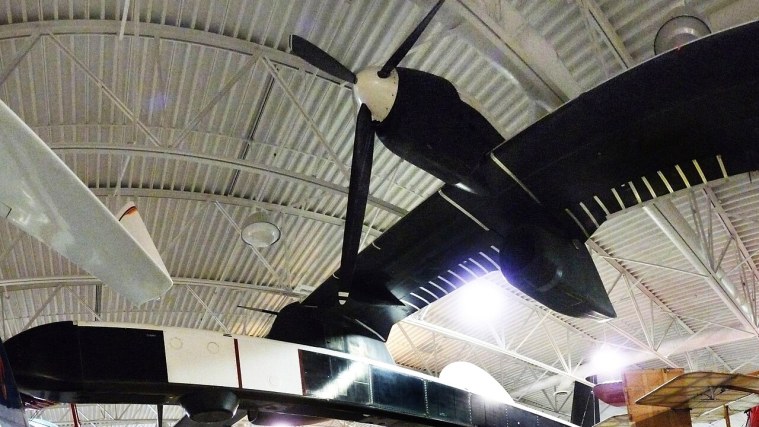
Photo: El Caganer from Flickr, transfered to commons by Waerfelu, CC BY 2.0 (cropped)
A stop on Hiller Aviation Museum: Unofficial Guide, a free self-guided tour.
The Boeing Condor hangs over the main gallery. Its wingspan of about 205 feet is wider than that of a Boeing 747, yet it was built to carry no one aboard.
The Condor was an unmanned reconnaissance aircraft developed by Boeing in the 1980s. It first flew in 1988, powered by two piston engines driving propellers, and was designed to stay aloft for days at very high altitude.
It set several marks. In 1989 it reached 67,028 feet, a world altitude record for a piston-powered aircraft, and it flew for more than 50 hours nonstop. It is also credited as the first aircraft to fly a fully automated flight from takeoff to landing.
Only two were built. The other belongs to the National Museum of the U.S. Air Force. The Condor's technology foreshadowed today's long-endurance military drones.
More on Wikipedia: Boeing Condor
Stops on this tour
- Boeing 747-100 Cockpit and Forward Fuselage
- Hiller Flying Platform
- Boeing Condor High-Altitude Reconnaissance UAV
- NASA AD-1 Oblique Wing Research Aircraft
- Wright Flyer Replica and Early Flight Exhibit
- Black Diamond - 1910 California Pioneer Aircraft
- Grumman HU-16 Albatross Amphibious Aircraft
- Boeing 737-200 Cockpit
- Flight Sim Zone
- Women in Aviation Gallery
- Aircraft Engine Collection
- Lockheed YO-3 Quiet Star
- San Francisco Airport Control Tower Beacon
- Drone Plex and Future of Flight Exhibit
- Michael King Smith Research Library and Museum Store