City Market - Four Blocks of Open Sheds
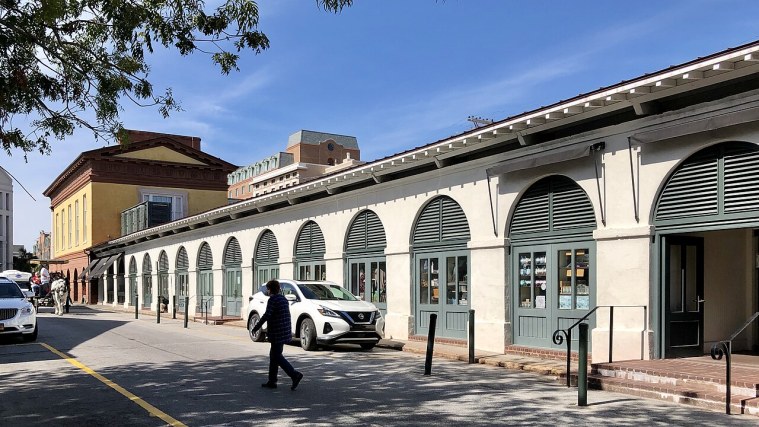
Photo: Warren LeMay from Covington, KY, United States, CC0 (cropped)
A stop on Charleston Historic District Walk, a free self-guided tour.
The temple-like building in front of you is Market Hall, designed by Edward Brickell White and completed in 1841 after fire destroyed the earlier headhouse. Behind it, low open sheds stretch four city blocks, about 1,240 feet, toward the harbor. Since 1899 the hall's upper floor has housed a Confederate museum run by the United Daughters of the Confederacy.
The land was given to the city in 1788 by Charles Cotesworth Pinckney and other owners, on the condition that it always be used as a market. For generations, butchers, fishmongers and farmers sold food here.
Despite a common belief, enslaved people were not sold at the City Market. Those sales took place at the Exchange, in the streets nearby and at marts like the one on Chalmers Street. Today, look for Gullah sweetgrass baskets, coiled by hand in a tradition with West African roots that Lowcountry families have passed down for generations. Then walk east through the sheds to East Bay Street and cross toward the water to return to the Pineapple Fountain, where you began.
Getting here: Walk back west to Meeting Street and head south about 650 meters (four-tenths of a mile) to Market Hall, the columned building on your left at Market Street.
Did you know?: Vultures that scavenged meat scraps kept the market clean well into the 20th century and were protected by law.
Photo op: From across Meeting Street, frame Market Hall's columns above the street; inside the sheds, ask before photographing basket makers at work.
More on Wikipedia: City Market · Charles Cotesworth Pinckney · Edward Brickell White · Gullah
Stops on this tour
- Pineapple Fountain - Charleston's Front Porch
- Old Exchange - Customs, Constitution and Captives
- Rainbow Row - Merchant Houses in Pastel
- The Battery - Seawall, Cannons and Pirates
- St. Michael's Church - The Steeple Over Broad Street
- Four Corners of Law - Church, City, County, Nation
- Old Slave Mart - Where People Were Sold
- Dock Street Theatre - A Stage Since 1736
- St. Philip's Church - A Steeple That Guided Ships
- Kahal Kadosh Beth Elohim - A Temple from 1840
- Mother Emanuel AME Church - Faith and Resilience
- City Market - Four Blocks of Open Sheds