Seneca Village - The Community Under the Park
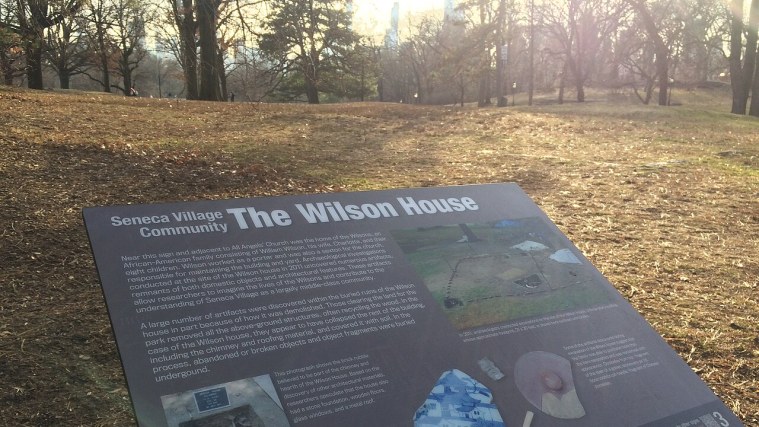
Photo: Allison Meier, CC BY-SA 2.0 (cropped)
A stop on Central Park Highlights Walk, a free self-guided tour.
The peaceful lawns and trees around you were once a village. In 1825 a young Black shoeshiner named Andrew Williams bought three lots here, and Seneca Village grew up around him. By the 1850s about 225 people lived here, in more than 50 houses, with three churches, a school and cemeteries. Most were African American, and many were landowners at a time when New York required Black men to own property worth $250 to vote. Irish immigrants also made homes here.
In 1857 the city used eminent domain to take all the land for the new park. Owners were paid, but the community was scattered and nearly forgotten for more than a century.
Archaeologists dug here in 2011 and found house foundations and thousands of everyday objects. Today signs from the Central Park Conservancy's Discover Seneca Village exhibit help you picture where homes and churches stood. Look for the information kiosk and the markers along the paths toward Central Park West.
Getting here: From the theater, walk north along the western edge of the Great Lawn and cross toward Central Park West to the paths near West 84th Street.
Did you know?: The granite blocks near the 85th Street entrance are often taken for a village house foundation, but the park's historian says they are from a 1930s sandbox.
Photo op: Frame one of the Seneca Village signs with the rocky slope and trees behind it, a reminder of a neighborhood hidden in plain sight.
More on Wikipedia: Seneca Village · Eminent domain
Stops on this tour
- Grand Army Plaza - A Golden General
- The Pond and Gapstow Bridge - The Classic View
- Wollman Rink - Skating Under the Skyline
- The Mall and Literary Walk - A Cathedral of Elms
- Bethesda Terrace - The Heart of the Park
- Cherry Hill - A Rest Stop for Horses
- Strawberry Fields - A Living Memorial
- Bow Bridge - The Park's Romantic Span
- The Ramble - A Wild Garden by Design
- Turtle Pond - From Reservoir to Wildlife Haven
- Delacorte Theater - Free Shakespeare Under the Stars
- Seneca Village - The Community Under the Park
- Belvedere Castle - The View From Vista Rock