Mudd Hall of Philosophy - A Monastery for Thinkers
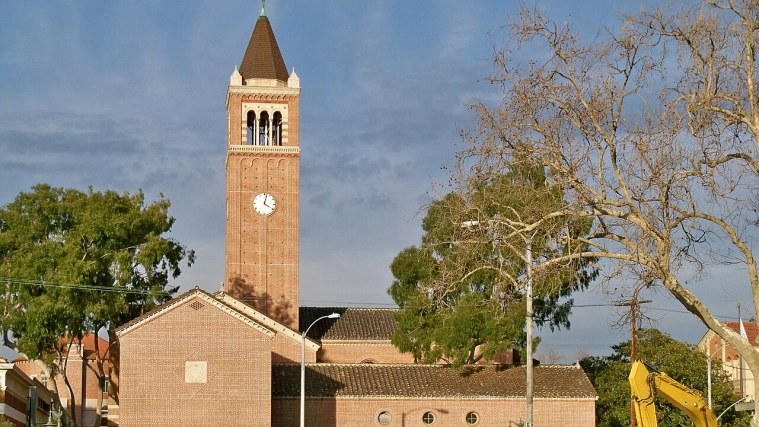
Photo: atgorden, CC BY 3.0 (cropped)
A stop on USC Campus Walk, a free self-guided tour.
With its cloister, tile roof and 146-foot clock tower, Mudd Hall looks like a medieval monastery, and that was the point. It was built in 1929 and 1930 for USC's new School of Philosophy and named for Seeley Wintersmith Mudd, a mining engineer whose family funded it.
The architect was Ralph Carlin Flewelling, whose father, Ralph Tyler Flewelling, was the philosophy professor who founded the school. Together they created a building that mixes Romanesque, Byzantine and Tuscan touches around a courtyard with a fountain at its center.
Look closely at the carvings. Over the south entrance, a figure of Diogenes holds up his lamp, the ancient philosopher said to have searched for an honest man. Inside, the Hoose Library of Philosophy is decorated with tile portraits of great thinkers.
Campus lore claims scenes from the 1939 film The Hunchback of Notre Dame were shot in this tower. It makes a good story, but historians say that film was shot elsewhere.
Walk the cloister quietly; classes are often in session.
Getting here: Walk south down Trousdale Parkway for about three minutes. Mudd Hall's tower rises on your right near the Exposition Boulevard end of campus.
Did you know?: A restoration completed in 2003 won Mudd Hall a Los Angeles Conservancy Preservation Award.
Photo op: From the courtyard, frame the clock tower above the cloister arches, or find the Diogenes carving over the south door.
More on Wikipedia: Ralph Tyler Flewelling · Diogenes
Stops on this tour
- Tommy Trojan - The Warrior at the Heart of Campus
- Bovard Auditorium - Where Film School Began
- School of Cinematic Arts - The House That Lucas Helped Build
- USC Village - Hecuba Meets Tommy
- Leavey Library - Built for the Digital Age
- Widney Alumni House - Where USC Began in 1880
- Doheny Library - A Grieving Family's Gift
- Alumni Park - The Campus Living Room
- Hahn Plaza - Rally Central
- Mudd Hall of Philosophy - A Monastery for Thinkers
- Los Angeles Memorial Coliseum - Three Olympics, One Stadium
- Exposition Park Rose Garden - From Racetrack to Roses